
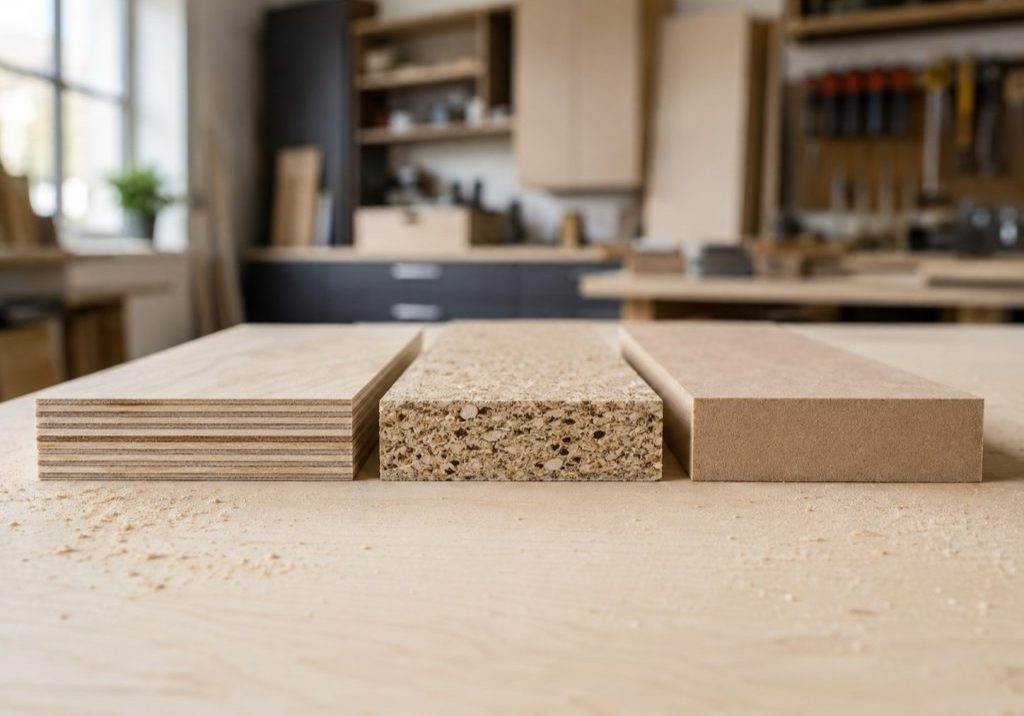
The doors are what you see. The boxes are what you actually buy, and the box material decides how a kitchen holds up at the sink, on every hinge, and under every loaded shelf. Cabinet boxes are built from one of three sheet goods: plywood, particleboard, or MDF. Once the kitchen is installed, the boxes disappear behind doors and end panels, which makes them the easiest place to cut cost without you noticing on day one. Plywood kitchen cabinets cost more, and the premium is real. In custom kitchen cabinets, the box material is a decision you get to make, not a spec you inherit. The differences come down to screw grip, moisture, weight, and cost, and each of the cheaper panels has one place it honestly belongs.
Doors Get the Looks, Boxes Do the Work
A kitchen cabinet is two products wearing one finish. Doors and drawer fronts get judged in the showroom. The boxes carry every hinge plate, drawer slide, shelf pin, and countertop load, every day, for decades. When a door sags or a slide pulls loose, the failure is rarely the hardware. It is the material the hardware was screwed into.
One label deserves early scrutiny: “solid wood cabinets” almost never means solid-wood boxes, and it should not. Wide solid panels move too much with humidity to make a stable case. Sheet goods are the right engineering for a box. The only question is which sheet.
The Three Sheet Goods Behind Every Cabinet Box
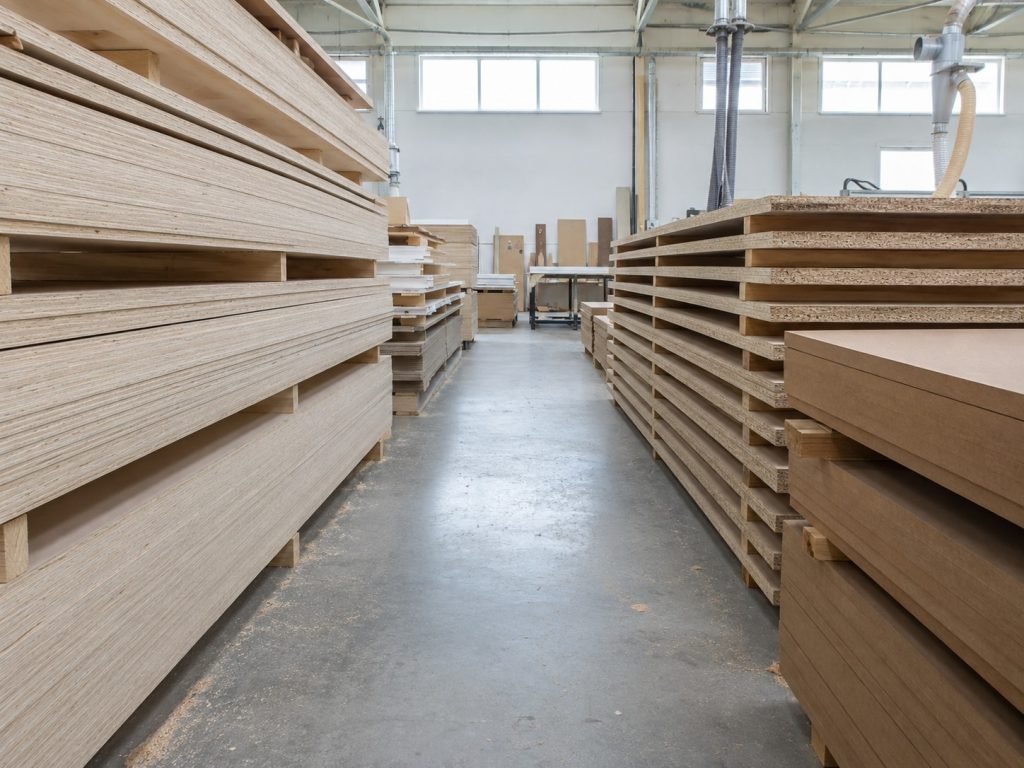
All three box materials are engineered wood panels. The difference is how far the wood is broken down before it is glued back together: whole veneers for plywood, small particles for particleboard, and individual fibres for MDF. That one fact predicts almost everything else about how each panel behaves.
What Plywood Is
Plywood is thin wood veneers stacked so each layer’s grain crosses the last, then bonded under heat and pressure. That cross-grain build is why it resists warping, cracking, and shrinkage, holds fasteners reliably, and stays strong for its weight.
Cabinet boxes use hardwood plywood with decorative faces, typically 5/8 or 3/4 inch thick on the sides, not the spruce sheathing sold for roofs. Cabinet plywood is also a graded, standardized product. Not every sheet marked plywood is equal, and the grade tells you which sheet you are getting.
What Particleboard Is
Particleboard is wood particles, the chips, shavings, and sawdust, bonded with resin under heat and pressure into a flat, consistent, low-cost panel. In cabinets it almost always wears a melamine skin, a decorative paper fused to the panel. Melamine is a surface, not a core: the scratch resistance is genuinely good, and the panel under it is still particleboard.
Grading matters here too. Cabinet-grade particleboard is graded under ANSI A208.1, and screw-holding is one of the properties the grade sets. The grade printed on the panel matters more than the word particleboard does.
What MDF Is
MDF is wood broken down to individual fibres, then pressed into a panel that is dense and uniform from face to face: no grain, no voids, and edges that machine glass-smooth. That homogeneous density is why medium-density fibreboard takes intricate, precise machining and finishing so well.
The same uniformity carries a cost inside a box. MDF is the heaviest of the three at cabinet thicknesses, and raw fibre swells wherever water finds it. Dense is not the same as durable in the places hinges and plumbing live.
Why Plywood Kitchen Cabinets Cost More and What That Buys
Sheet for sheet, particleboard costs the least, MDF sits in the middle, and cabinet-grade plywood costs the most. Across a full kitchen, plywood boxes add a real but modest premium, and it goes into the part of the kitchen that works hardest and shows least.
Screw Grip Where Hinges and Slides Land
Plywood grips a screw with layers of real wood grain, so hinge plates and drawer-slide screws bite and stay put, and they can be reset if a door ever needs adjusting. In particleboard, the edge of the panel is the weakest place to land a screw, and that is exactly where hinges and slides go.
Independent published testing of five North American particleboard makers found that none reached the industry’s recommended value for edge screw grip, and in the companion MDF tests some mills beat the marks while others missed them. Two takeaways: plywood’s grip is the dependable one, and quality varies mill to mill even within a single material.
Moisture at Sinks and Dishwashers
Kitchen water shows up small and local: a drip under the sink, a seeping dishwasher line, a fridge line that lets go. The box material decides whether that event is a wipe-up or a rebuild.
The lab picture is blunt: soak a standard interior-grade particleboard panel and it swells roughly 14 percent in two hours. That is a full-immersion test, an illustration of the failure mode, not a claim about kitchen humidity. Once particleboard swells, it stays swollen, so a dishwasher leak into a particleboard sink base is usually permanent damage, not something that dries out flat again.
Moisture-resistant particleboard exists, but as an added-cost variant, not the base product. MDF also swells where water reaches raw fibre. Plywood tolerates a wetting the other two do not.
Weight, Shelf Sag, and the Loads a Kitchen Applies
At the same thickness, MDF is the heaviest of the three and plywood the lightest. The difference matters most in wall cabinets, which hang their whole weight on a few screws, and in tall doors, where every hinge carries the load on every swing.
Load a wide shelf with dishes and leave it for a year: particleboard and MDF sag sooner and stay sagged, while plywood holds its line longer. Wide runs deserve plywood shelves or extra support, whatever the material.
Under the cabinet industry’s A161.1 certification testing, shelves and bottoms carry 15 lb per square foot for seven days, mounted wall cabinets are loaded to 600 lb, and doors run 25,000 open-and-close cycles. That is the duty a box material signs up for.
Where Each Material Honestly Belongs
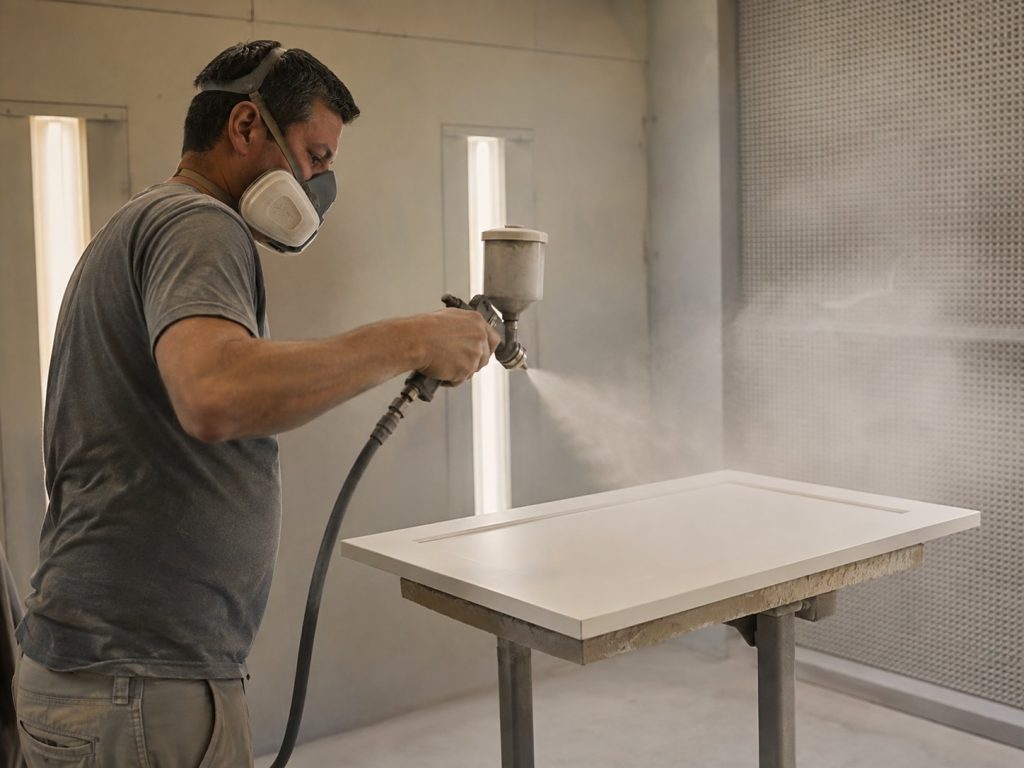
None of the three is a scam, and none is universal. The honest answer is a placement answer: boxes, doors, and dry-area casework each have a right material.
Painted Doors: Where MDF Earns Its Place
On a painted shaker door, MDF stops being the budget option and becomes the correct one. Its uniform, grain-free body machines a routed profile cleanly and keeps a painted finish intact, while a solid-wood door moves with humidity and can crack the paint line at its joints. MDF, or an MDF-core hybrid, is a legitimate and often superior choice for painted door styles.
The same logic runs the other way. The properties that make a stable painted door make the wrong box, because a box has to grip screws and shrug off water. Doors and boxes are different jobs. Specify them separately.
Where Particleboard and Melamine Make Sense
Melamine-clad particleboard earns its keep in dry, budget-conscious work: garage and utility cabinetry, commercial casework on a lifecycle budget, and interiors where cost matters more than decades of service. The panel industry itself lists cabinets, shelving, furniture, and store fixtures among particleboard’s common uses. Melamine interiors are also standard, defensible practice in custom closets, where panels stay dry and the surface stands up to daily wear.
The one condition: you know what you are buying, and the price reflects it. Particleboard sold at a premium price is the problem, not particleboard itself.
Plywood vs Particleboard vs MDF at a Glance
None of the three wins everywhere, and every difference that matters traces back to the same fact: how far the wood was broken down before it was glued back together.
| What We Compare | Plywood | Particleboard | MDF |
| Made from | Cross-laminated wood veneers | Wood particles and resin | Wood fibres pressed dense |
| Screw-holding | Strong and resettable | Weakest at panel edges | Variable by mill |
| Water response | Tolerates a wetting best | Swells and stays swollen | Swells at raw fibre |
| Weight | Lightest | Middle | Heaviest |
| Wide shelves | Holds its line longest | Sags soonest | Sags under sustained load |
| Best kitchen role | Cabinet boxes and shelves | Budget and dry-area casework | Painted doors and profiles |
| Relative cost | Highest | Lowest | Middle |
Formaldehyde and Safety: What Canadian Law Requires
Formaldehyde is the worry buyers attach to all three panels, and Canadian law has already answered most of it. Since January 2023, composite wood products sold in Canada must meet federal formaldehyde emission limits: 0.05 ppm for hardwood plywood, 0.09 ppm for particleboard, 0.11 ppm for MDF, and 0.13 ppm for thin MDF. Plywood’s cap is the strictest of the three.
Two details are worth acting on. Buyers who want lower still can ask for no-added-formaldehyde (NAF) or ultra-low-emitting (ULEF) panels, which the rules formally recognize. And a US panel marked TSCA Title VI compliant meets the same numbers, so a US label is not a loophole.
Five Questions to Ask Before You Approve a Cabinet Quote
Most quotes describe doors in detail and boxes in a single line, if that. Five questions close the gap:
- What are the boxes made of, by name: plywood, particleboard, or MDF?
- What grade or standard does the panel meet? Plywood, particleboard, and MDF are all graded products, and the grade matters more than the material’s name.
- How is the sink base built, and what happens under it when a line leaks?
- Are exposed sides and interiors finished, or does the box show raw panel?
- Does “solid wood” in this quote mean the doors, the boxes, or just the frames?
Not all plywood is equal either: thin faces and voided cores exist, which is exactly why the grade question earns its place.
Plywood Boxes Are Our Standard, Not an Upgrade
Screw grip, moisture tolerance, and shelf stiffness all show in how a shop builds. At Luxe Deco Kitchen, premium plywood cabinet construction with solid-wood dovetail drawer boxes and soft-close hardware is the standard for our custom kitchen cabinets in the GTA, not an upgrade you have to negotiate. Every door, drawer, and dovetail is cut and finished in our own workshop, nothing outsourced and nothing arriving flat-packed, the way we have built for more than twenty-five years.
We design, build, and install for homeowners across the Greater Toronto Area. If you are comparing quotes and want the box material named in writing, book a design consultation and bring the hard questions.